 Skip to content

Introduction
In recent years pink Himalayan salt has become popular somehow marketed as a healthier and more “natural sounding” alternative to regular table salt. Known for its gorgeous pink hue and its claims of being full of essential minerals, the salt is now a mainstay in gourmet kitchens and health routines. But is pink salt better for you?
The curiosity stems from the belief that this ancient rock salt, mined from the Himalayas, retains beneficial trace minerals lost in processed table salt. Proponents tout benefits of pink Himalayan salt like improved hydration, better electrolyte balance, and even detoxification. However, a closer look at pink salt vs regular salt and comparisons with sea salt reveals a more nuanced picture.
Briefly, Himalayan salt vs regular salt shows minimal differences in sodium content, with pink salt containing tiny amounts of trace minerals like iron and magnesium. Sea salt or Himalayan salt—both unrefined—offer similar profiles, but neither provides significant nutritional advantages over the other.
Pink salt may taste good, and it’s certainly pretty to look at, but there isn’t scientific evidence to show that it has any health benefits over normal table salt. This article delves into the facts, myths and practical uses so you can decide whether it’s worth switching. Moderation is still key, as all salts are mostly just sodium chloride.
What Is Pink Himalayan Salt?
Pink Himalayan salt, also known as pink salt, is a type of rock salt harvested from the Khewra Salt Mine in Pakistan, located near the foothills of the Himalayas. This one, one of the biggest and oldest in the world, mines salt deposits formed by ancient seas more than 250 million years ago.
Most of the mining is done by hand: workers extract large blocks of salt using traditional tools, which are then crushed into a variety of grain sizes. Pink Himalayan salt is unconventionally compared to refined table salt, which is processed stripping the natural salts of its minerals due to heavy refining and bleaching.
Its color is due to trace minerals such as rust (iron oxide) and a little magnesium, potassium and calcium. It varies in color from pale pink to deep reddish tones due to these impurities.
Unrefined pink Himalayan salt, but still containing bit of impurities and trace minerals is advertised as “pure” unlike regular table salt which has spent a great deal of time being processed till all the goodness is gone after it was refined to remove impurities then had anti caking agents and iodine added. But it’s still around 98 percent sodium chloride.
The only difference is texture (coarser crystals), flavor (a little more complex with the addition of minerals), and appearance. And whereas regular table salt is powdery and fine, pink salt’s larger grains make it a favorite for finishing dishes (or grinding fresh).

Uses for Himalayan Salt – Select Salt
Nutritional Profile of Pink Salt
Pink Himalayan Salt Nutrition Compared to table salt, Pink Himalayan salt is quite similar in its basic nutritional content and composition (it’s about 98% sodium/potassium chloride).
Sodium levels are nearly identical as well (about 2,300 mg per teaspoon), though larger crystals can translate to a bit less sodium by volume in some brands.
The critical distinction is trace minerals: Pink salt boasts a small amount of iron (it’s what gives it the light color) as well as calcium, potassium, and magnesium, with slightly lower amounts of sodium than plain ol’ salt.
But these are in such small amounts. You’d have to eat astronomically high amounts (well in excess of safe sodium guidelines) of these minerals to get any significant nutrition value from them.
The role of minerals in health: In theory, they could help support electrolyte balance or other minor functions, but there is no evidence that dietary sources of salt have any significant impact on overall health.
Table salt is also sometimes iodized, meaning a manufacturer has added iodine so it’s easier to ingest and protect against thyroid disease — which pink salt doesn’t have naturally.
Overall, no substantial nutritional superiority.
Healthy Salt Company | Boulder Salt Company
| Mineral | Pink Himalayan Salt (approx. per tsp) | Regular Table Salt |
| Sodium | ~2,200–2,300 mg | ~2,300 mg |
| Iron | Trace (0.0001–0.01%) | None |
| Magnesium | Trace | None |
| Potassium | Trace | None |
| Iodine | None (unless added) | Often added |
Benefits of Pink Himalayan Salt
The benefits of pink Himalayan salt are often exaggerated, but there are some potential perks backed by limited evidence.
Potential health benefits are improved hydration and electrolyte balance from trace minerals like potassium and magnesium — useful during exercise or in hot climates when added to water. But the quantities are too negligible to have any real effect relative to food sources.
Its mineral complexity can add subtle flavor to cooked foods. For wellness, pink salt baths can also soothe skin (like any other salt) or relax muscles, though not in ways unique to this particular type.
The realities: Sound evidence of any health advantage over regular salt; those that do often have the same downsides. Statements about enhanced respiratory health (from using a salt lamp/inhaler) or detoxification are unfounded. It’s essentially sodium chloride with some trace minerals that are not of any substantial proven impact, according to Mayo Clinic and Healthline.
Myths include “84 minerals” providing nutrition—true in presence, but quantities are trivial. It’s not “lower sodium” meaningfully.
In summary, benefits of pink Himalayan salt are mostly culinary and aesthetic, not transformative for health.
Pink Salt vs Regular Salt
Pink salt vs regular salt highlights processing and minor composition differences.
Throughout history, common table salt is one of the most refined and processed foods you will find; mined by hand from rock or evaporated from sea water, bleached and anti-caking agents. This also removes impurities, and in the process depletes natural minerals leaving salt ( NaCl ) with added iodine.
Pink salt is also unrefined driving these minerals and chemicals before it for a bit of color and mild flavor variations — some say, fainter or more nuanced.
- Taste: Pink salt may taste “cleaner” or less bitter than table salt, and several thousand types of minerals can be found in the trace amounts.
- Mineral content: Pink has some (iron, etc.), but negligible nutritionally.
- Processing: The pink is “natural,” no additives; table salt does not clump.
- Health impact: Both are high in sodium, which can lead to hypertension when overconsumed. No proof pink lowers blood pressure or provides benefits. Sodium considerations: AHA recommends <2,300 mg/day; additional from all salts is a heart concern.
- Culinary: Sprinkle for finishing/garnish; table for baking (dissolves flat).
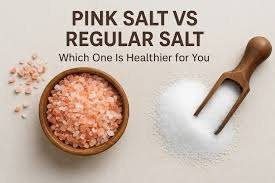
Himalayan Salt vs Regular Salt
Himalayan salt vs regular salt echoes the above:
refined vs natural:
- Processed table salt strips minerals to create purity; Himalayan Pink Salt maintains it.
- Effect on blood pressure: Same sodium load — no change.
- Overall health: No documented advantage to Himalayan.
- Food uses: Himalayan is great in grinders or as a finishing salt for texture/crunch.
Sea Salt or Himalayan Salt: Which Is Better?
Sea salt or Himalayan salt—both unrefined alternatives.
Sea salt from evaporate seawater varies by source (Celtic gray, fleur de sel); contains traces such as magnesium but possibly contaminants (microplastics in oceans today).
Himalayan from early deposits—unadulterated stable minerals.
Trace elements: Indistinguishable traces; both negligible.
Pros/cons: Sea — variety of flavors, moist texture; possibility of contamination. Himalayan—pure, pretty; more expensive.
For everyday use: No healthier than sea salt or table salt. Choose for taste/preference.
8. Is Himalayan Salt Good for You?
Is Himalayan salt good for you? In moderation, yes—like any salt for flavor/electrolytes.
Health benefits: Slightly greatened flavor or mild skin soothing in baths.
Risks of overdonsumption: Inflamed heart, high blood pressure.
Compared to regular: No superior.
Is Himalayan Salt Good for Health?
Is Himalayan salt good for health?
- Cardiovascular: Same sodium perils.
- Hydration/electrolytes: Trace help negligible.
- Science perspective: Studies (Healthline, Mayo) show no benefits.
- Misconceptions: Not detoxifying or mineral rich enough.
How to Use Pink Himalayan Salt Safely
Suggested intake: < 1 tsp/day of total salt.
Cooking tips: Grind fresh, use as a finish.
Balanced diet: Pair with veggies/fruits.
Avoid over: Monitor sodium.
Common Myths About Pink Salt
Myths: Lowers sodium (no), detoxifies (no), air-purifying lamps (no evidence).
Vs evidence: Marketing hype; scientifically similar to other salts.
Informed choices: Enjoy for taste, not health miracles.
Conclusion
Is pink salt better for you? No strong evidence supports it over regular or sea salt. It’s aesthetically pleasing and flavorful, but nutritionally similar—primarily sodium.
Emphasize moderation and balanced diet for health.
Practical: Use pink for variety, but don’t expect miracles.
Tips for Buying Authentic Himalayan Salt
Look for reputable sources; avoid fakes with dyes. Coarse crystals from Pakistan mines.
FAQ Section
What is the difference between Himalayan salt and table salt?
Processing and traces; similar sodium.
Can pink salt lower blood pressure?
No—same sodium.
Is sea salt healthier than Himalayan salt?
Comparable; no clear winner.
Can you use pink salt for cooking daily?
Yes, but moderate.
Are there risks of consuming too much pink salt?
Yes, like any salt—hypertension.
Recommended:


